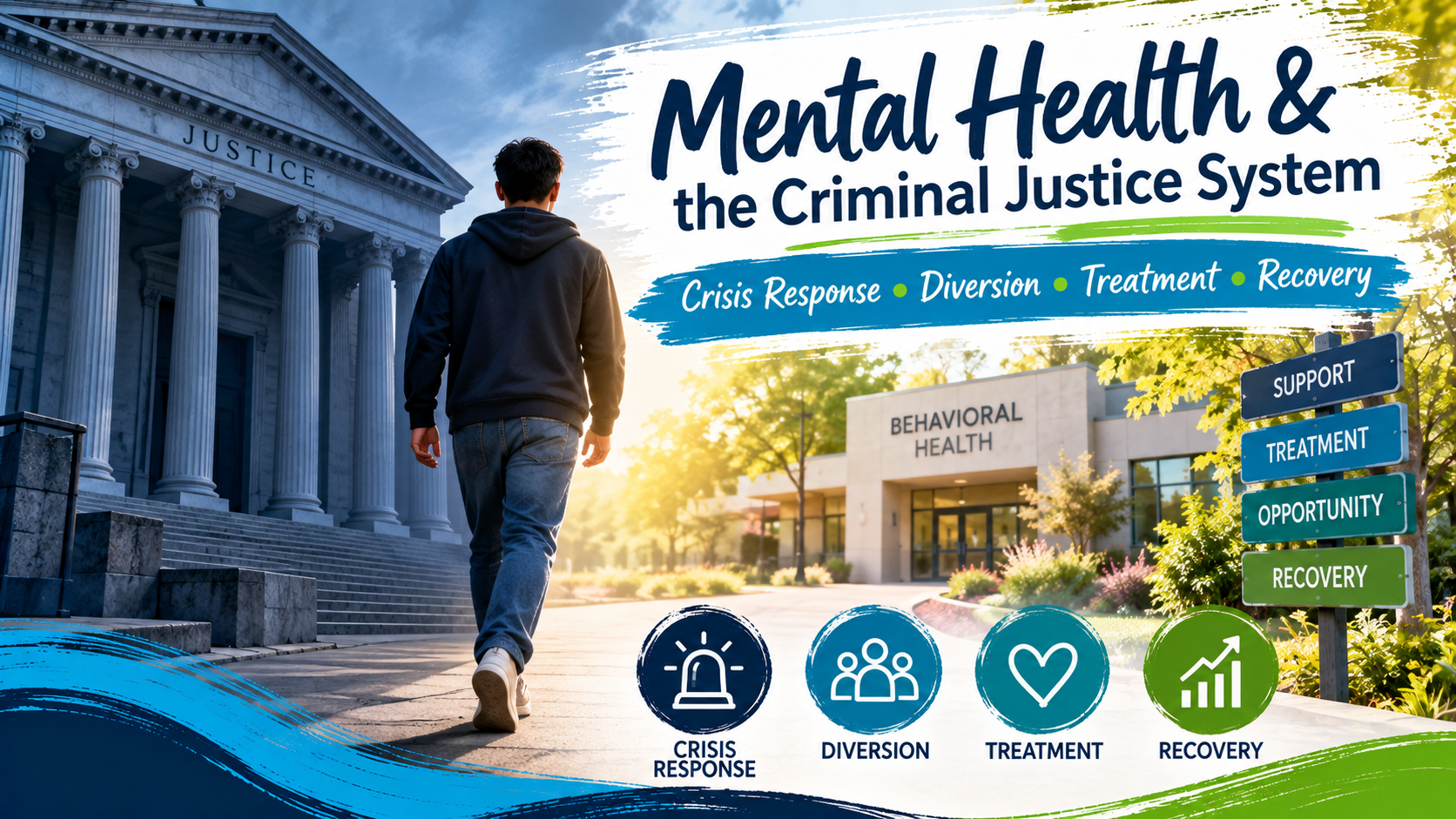
When Mental Health and the Criminal Justice System Intersect
A mental health crisis should not automatically become a criminal justice crisis.
Yet across the United States, people living with mental health conditions are significantly represented in jails and prisons. Federal Bureau of Justice Statistics data found that about 43% of people in state prisons and 23% of people in federal prisons reported a history of a mental health problem.
Behind those numbers are individuals, families, law enforcement officers, courts, treatment providers, and communities trying to respond to situations that can be incredibly complicated.
Sometimes an encounter with the justice system begins with behavior connected to untreated or inadequately supported mental health needs. Other times, mental illness is only one part of a person's circumstances.
Either way, one principle matters:
When treatment, crisis intervention, and community support are appropriate, people should have meaningful opportunities to access them.
Mental Illness Is Not a Crime
Having a mental health condition does not make someone a criminal.
It also does not mean that people should never be held accountable for criminal behavior.
Those two ideas can exist together.
A strong community response recognizes public safety and accountability while also asking an important question:
Is incarceration actually the most appropriate response, or could treatment and community-based support produce a better outcome?
New York's own Judicial Task Force on Mental Illness recognizes that mental illness is not a crime and that court involvement can sometimes result from inadequate support. Its work includes expanding diversion opportunities and encouraging trauma-informed approaches throughout the court system.
Crisis Response Can Make a Difference
What happens during a behavioral health crisis can influence everything that follows.
A person experiencing severe emotional distress, psychosis, suicidal thoughts, substance-use concerns, or another behavioral health crisis may need a response designed to de-escalate the situation and connect them with appropriate care.
New York's crisis system includes several levels of response. 988 connects people with trained crisis counselors. Mobile Crisis teams can provide voluntary, short-term intervention in the community, while crisis stabilization centers and Comprehensive Psychiatric Emergency Programs provide additional levels of behavioral health crisis care. New York's Office of Mental Health also supports Crisis Intervention Team (CIT) initiatives. These programs involve partnerships among law enforcement, mental health providers, emergency services, criminal justice agencies, and people with lived experience and their families. One goal is to de-escalate situations and divert people from the criminal and juvenile justice systems when appropriate.
What Is Diversion?
Diversion is an alternative approach for eligible people whose behavioral health needs and circumstances make community-based intervention appropriate.
Instead of relying exclusively on traditional criminal justice processing or incarceration, diversion programs can connect eligible participants with treatment and support while still recognizing public-safety considerations and accountability.
Depending on the program and individual, services might involve:
- Mental health treatment
- Substance-use treatment
- Case management
- Housing support
- Benefits assistance
- Education or employment services
- Peer support
- Court supervision
Diversion isn't appropriate for every person or every criminal case. Eligibility depends on the particular program, charges, clinical circumstances, public-safety considerations, and applicable law.
But when diversion is appropriate, it can create another path.
Mental Health Courts in New York
New York has specialized Mental Health Courts designed to connect eligible justice-involved individuals living with mental illness to court-supervised, community-based treatment.
The state's stated goals include improving public safety, reducing repeated involvement with the justice system, improving identification and assessment of mental health needs, connecting participants with appropriate services, and improving coordination between the behavioral health and criminal justice systems.
Treatment plans can include mental health and substance-use treatment, case management, supported housing, educational and vocational services, and assistance accessing public benefits. Participation is based on eligibility requirements and is intended to involve informed and voluntary choice.
What About the Southern Tier?
This is especially relevant to a StrongSteps audience.
Within New York's Sixth Judicial District, the state court system currently identifies Mental Health Courts in Elmira City Court and Ithaca City Court.
That illustrates something important: access to specialized programs isn't necessarily identical from one county to another.
Support Shouldn't End at Release
Another critical point occurs when someone returns to the community.
A person leaving jail or prison may need much more than a list of telephone numbers.
Stable housing, behavioral health treatment, medications, identification documents, health coverage, employment, transportation, substance-use treatment, benefits, family support, and connection with community services can all affect someone's ability to regain stability.
New York's Office of Mental Health specifically identifies timely access to mental health services for people on parole and probation, alternatives to incarceration, and coordination with community providers among its forensic-services activities.
A successful transition back into the community should involve more than asking someone not to return to the justice system.
Families Need Navigation Too
Justice-system involvement doesn't affect only the individual.
Families may suddenly be trying to understand courts, treatment programs, probation, insurance, medications, housing, benefits, and behavioral health services at the same time.
They may not know which system is responsible for what.
That's why community resource navigation matters.
Helping someone understand available resources does not mean excusing harmful behavior or interfering with the justice system.
It means helping individuals and families understand what behavioral health and community supports may be available to them.
Treatment, Accountability and Public Safety Can Work Together
This conversation doesn't have to be framed as choosing between public safety and mental health care.
Communities need both.
When someone presents an immediate danger, emergency intervention may be necessary. When a crime has occurred, accountability may be necessary.
But when untreated behavioral health needs are contributing to repeated crises or justice-system involvement, addressing those needs can also be part of protecting the community.
New York's Mental Health Courts explicitly identify both public safety and improved quality of life for people with mental illness among their goals. The question shouldn't simply be:
“What did this person do?”
We should also be willing to ask:
“What does this person need to reduce the chances of this happening again?”
Building a Better Community Response
At StrongSteps Behavioral Health Foundation, we believe behavioral health support should be accessible before, during, and after difficult moments in someone's life.
That includes people whose lives have intersected with the criminal justice system.
A person can be held accountable and still deserve dignity.
A person can have made mistakes and still recover.
A person can have a criminal record and still build stability.
And a person experiencing mental illness should not be defined solely by a diagnosis, an arrest, or the worst moment of their life.
Stronger communities are built when behavioral health providers, peers, families, courts, law enforcement, schools, community organizations, and other systems are willing to work together.
Sometimes preventing the next crisis begins by responding differently to the one happening today.